As AI compresses execution, value shifts to the layer that connects data, decisions, and outcomes.
Organizations exist to make decisions under uncertainty, and every role ultimately contributes to improving those decisions and the actions that follow.
To make a decision, three things are required: understanding the business context, processing information through data and systems, and translating that information into actions that can be executed in the real world.
This is why the so-called “middle layer” exists. Business problems are ambiguous and context-heavy, while data systems are structured and precise. Bridging this gap—turning messy questions into structured analysis and then into concrete actions—is not trivial.
AI is now changing the cost of processing information across this system. Tasks like querying data, generating reports, building models, and even orchestrating workflows are becoming faster and cheaper, compressing large parts of execution.
This creates the impression that intermediary roles will disappear, leaving only business experts on one side and engineering experts on the other.
But this view assumes that once information is processed, the right decision becomes obvious. It does not. Decisions still require context, trade-offs, risk evaluation, and judgment—especially in environments where accountability and regulation matter.
If the translation layer is removed, the system does not become more efficient—it becomes misaligned. Engineers can build technically correct systems that fail to address real business needs, while business leaders may struggle to convert insights into consistent and scalable actions.
What AI actually removes is low-level execution within the system, not the need to connect its parts.
As a result, the role does not disappear—it shifts. The focus moves away from producing information and toward shaping decisions, defining policies, and ensuring that insights lead to meaningful action.
The real distinction is no longer between business and engineering. It is between those who execute systems and those who ensure those systems lead to effective decisions.
Both roles are essential, but neither creates value in isolation. Data and models generate information, but value is created only when that information is translated into decisions, actions, and measurable outcomes.
As AI reduces the cost of execution across data, models, and workflows, the bottleneck shifts to decision-making—what to do, when to do it, and why.
This does not eliminate the middle layer. It elevates it into the most critical part of the system, even as parts of its execution are automated.
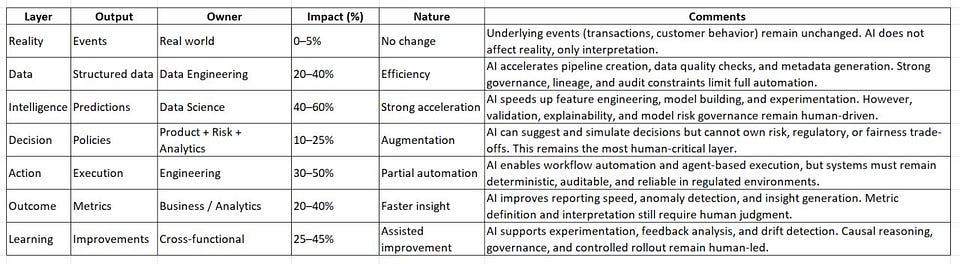
The system still depends on connecting reality, data, intelligence, decisions, actions, outcomes, and learning in a coherent loop. The difference is that this connection—once implicit and undervalued—now becomes explicit, measurable, and the primary driver of value.
Checkout my new book here: https://ankit-rathi.github.io/store/